KIDILL Fall/Winter 2026–27 “HEAVEN”: when silence becomes the ultimate punk manifesto
For Autumn-Winter 2026–2027, KIDILL makes a radical decision: silence. Out with the spectacular staging, the performative artifice, the visual excess. Hiroaki Sueyasu chooses minimalism as his creative gesture, letting the clothes and bodies breathe. In this deliberately stripped-down space, HEAVEN emerges as a powerful, almost intimate statement—a whispered punk, but impossible to ignore.
From its inception, KIDILL has been rooted in punk, not merely as an aesthetic, but as a language of survival. Sueyasu's gaze remains fixed on contradiction: chance and fate, chaos and stillness, audacity and fragility, cuteness and hardcore. Here, nothing is resolved. Everything coexists. Clothing becomes a collision site where opposing values clash and assert themselves simultaneously. For KIDILL, fashion acts as a means of stabilizing the mind, of regaining a precarious balance amidst the chaos.
Tension as essence
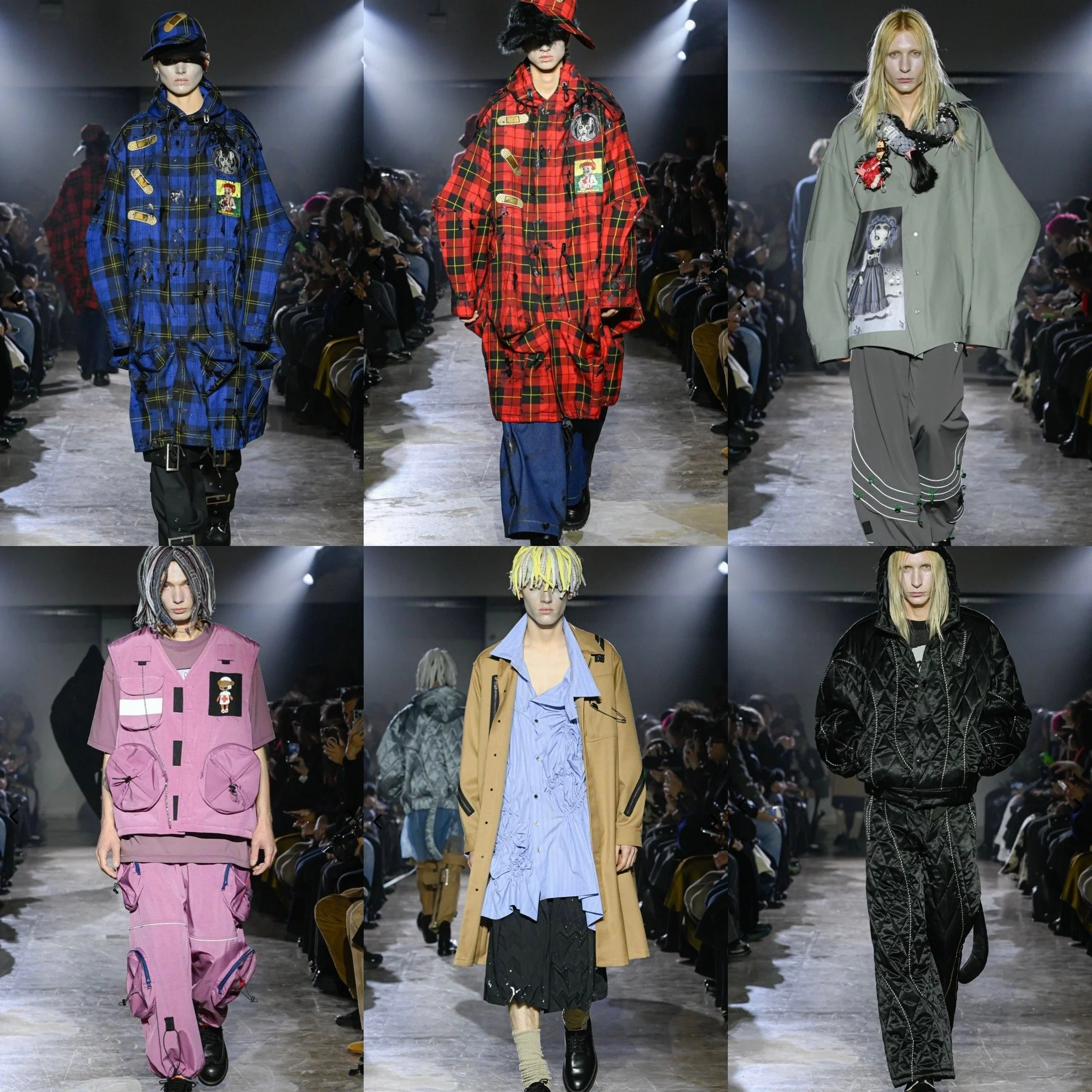
The Fall/Winter 2026–27 collection condenses these tensions into each piece. Smoky, deliberately muted palettes are abruptly contrasted with black silicone degradation effects. Softness is systematically challenged by structure. A key moment of the show: the MA-1, created in collaboration with Alpha Industries, where military rigor is enveloped in ethereal tulle. A radical blurring of the lines between femininity and aggression, protection and vulnerability.
Art permeates the collection. The works of Trevor Brown, a key figure in the Tokyo underground scene for over thirty years, appear as narrative fragments: oversized angel and demon wings engulfing the body, Mod coats with sharp lines, layers of tulle intersecting graphic images of young girls. Each element embodies an opposition, a threatened innocence, a fragile purity in constant tension.
Excess as vocabulary
The punk aesthetic, instinctively mastered by Sueyasu, is pushed to the point of saturation. Cut fabrics, quilted skirts, traditional tartans, bondage straps, safety pins, metallic embellishments, piping that accentuates the body's contours: every detail contributes to a raw and deliberate visual language. The materials oscillate between rich jacquards and reflective surfaces, highlighting the constant interplay between heritage and futurism.
The collaboration with Umbro pushes this logic to its extreme: more than forty adjustment points are integrated into the panel transitions, transforming garments into modular, almost living structures. Yet, behind this apparent anarchy, technical rigor remains. Working with teams specializing in bespoke tailoring allows precision and a rebellious spirit to coexist on the same level.
An aesthetic of the unfinished
Sueyasu's cultural universe—everyday London scenes, underground chaos, early 1990s Tokyo, cyberpunk remnants—continues to fuel KIDILL's DNA. When personal memory meets the present, incompatible forces emerge, deliberately left exposed. The designer rejects any polished sophistication, preferring the power of what remains raw, imperfect, unfinished.
HEAVEN is in no way a conventional utopia. For Sueyasu, it represents a space of liberation from taboos and oppression, a direct questioning of social norms. A symbolic territory where child and adult, destruction and fantasy, can coexist. In KIDILL's world, even chaos can become a form of paradise.
With Fall/Winter 2026–27, KIDILL forcefully reaffirms what constitutes its essence: fashion as an act of freedom, an unfiltered vision of the future, where contradictions are not corrected, but celebrated.